 Aruba Photoshoot
Aruba Photo Spots: the Map, the Light, and Which Session Goes Where
Most lists of Aruba photo spots print the same seven beaches and leave out the three things that decide your photographs: what hour the light works, what the road to get there demands, and whether any bookable photographer will actually take you. This page fixes all three. The 19 spots below sit on one interactive map with coordinates checked against open map data, the hour each one photographs best, the vehicle it needs, and the photo sessions that name it, joined from the operators' own listings rather than guessed.
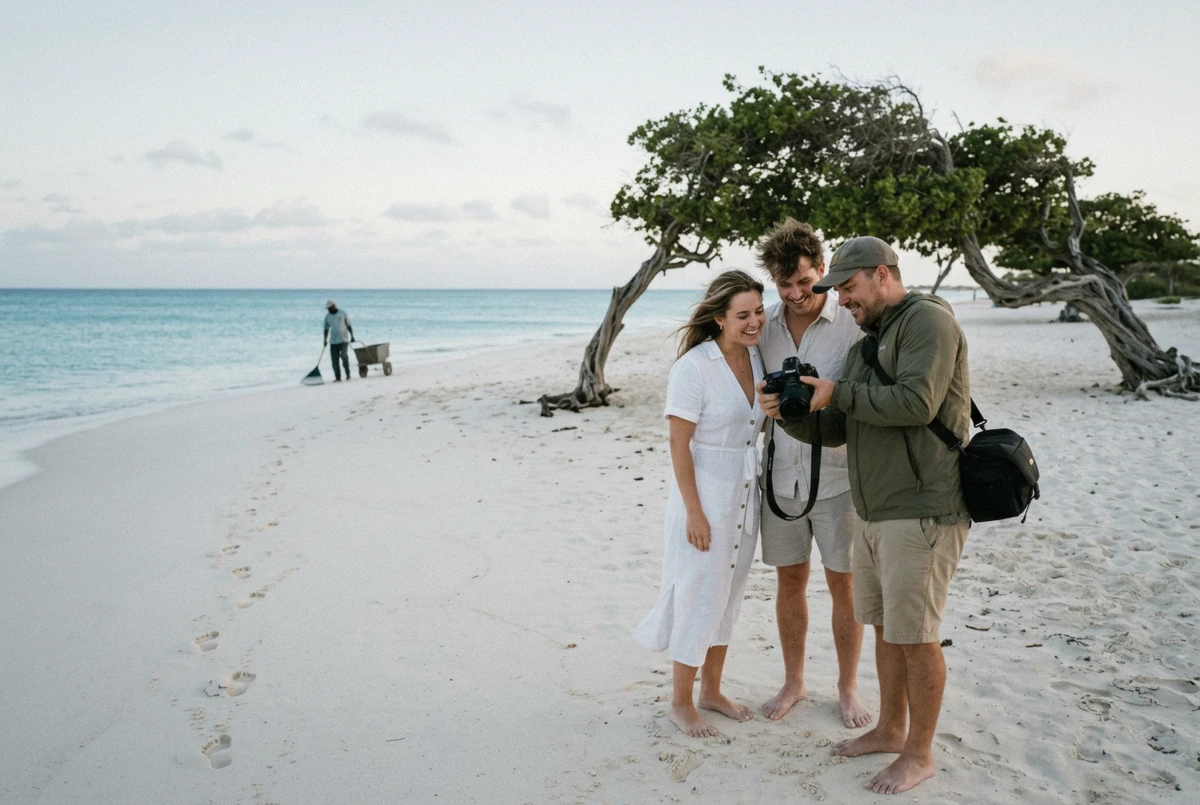
Eagle Beach just after sunrise: the island's most photographed sand, and empty for about an hour a day.
Quick answer
Aruba's photogenic geography splits cleanly in two. The leeward west coast (Eagle Beach, Palm Beach, Arashi, Boca Catalina) is calm, white and where every bookable session shoots; you can reach all of it in a normal rental car. The windward east and the interior (Arikok, the Natural Pool, Andicuri, Blackstone) are dramatic, rough and largely off-limits to a two-wheel-drive car and to every photographer on the booking platform. The light window is short at 12° north: sunset moves from 18:11 in November to 19:10 in July, and midday on white sand is unusable.
Key takeaways
- Every session in the comparison catalogue shoots the leeward coast, so the wild half of the island is yours to photograph
- The Natural Bridge collapsed in 2005 and still appears on lists of things to photograph; the smaller Baby Bridge beside it survives
- The Natural Pool needs a 4x4, a UTV or a horse, and rental car insurance does not cover that track
- Two fofoti trees on Eagle Beach are the island's signature frame, and they are not divi-divi trees, whatever the captions say
- Best light, spot by spot, plus the full photo day that strings the good hours together
All 19 Aruba Photo Spots at a Glance
One row per spot. "On a session" means a bookable photo session names that location or works that stretch of coast; the join comes from the operators' listings. Full detail on every spot sits under the map.
| Spot | The frame | Best light | Getting there | On a session |
|---|---|---|---|---|
| Eagle Beach | Wide white sand, low turquoise water | Golden hour | Any car, free parking | Yes: 3 sessions |
| The fofoti trees | Two wind-bent trunks against the sea | Sunrise or last light | Roadside on Eagle Beach | Yes, within the beach sessions |
| Palm Beach | Hotel strip, piers, watersports | Early morning | Any car | Yes: 3 sessions |
| Hadicurari / Fisherman's Huts | Kite sails over shallow water | Late afternoon | Any car | Yes: the parasail flight |
| Arashi Beach | Calm shallows, sun straight down the water | Late afternoon to sunset | Any car | Yes: family session |
| Boca Catalina | Clear cove, low limestone ledges | Before 10am | Any car, small lay-by | Yes: family session |
| Tres Trapi | Three stone steps into clear water | Early morning | Any car, roadside | No session |
| California Lighthouse | White tower on a dune ridge | Last 30 minutes of light | Any car, paved to the top | No session |
| Alto Vista Chapel | Ochre chapel alone on a cactus hill | Early morning, or overcast | Any car, paved | No session |
| Oranjestad | Dutch colonial colour, painted facades | Morning, before the cruise crowds | Any car, paid parking | Yes: family session |
| Mangel Halto | Mangrove channels and clear shallows | Morning | Any car | No session |
| Baby Beach | Shallow lagoon arc at the island's tip | Morning | Any car, 1 hour drive | No session |
| Casibari Rock Formation | Boulder stacks with a climbable top | Late afternoon | Any car, paved | No session |
| Ayo Rock Formation | Boulders, petroglyphs, open scrub | Morning | Any car, paved | No session |
| Bushiribana Gold Mill Ruins | Stone ruin on a windward cliff | Late afternoon | Rough coastal track; 4x4 advised | No session |
| Natural Bridge (collapsed) | Fallen span and the surviving Baby Bridge | Midday works: it faces the surf | Graded track | No session |
| Andicuri Beach | Rough bay in a rock amphitheatre | Morning | 4x4 recommended | No session |
| Blackstone Beach | Black volcanic pebbles, wild surf | Any hour; it is about weather | 4x4 and a walk | No session |
| Natural Pool / Conchi | Rock-ringed pool in the surf | Morning, before the tours | 4x4, UTV, horse or hike only | No session |
How Much Aruba Do You Have?
If you have one evening
Eagle Beach and the fofoti trees, an hour before sunset. It is the island's signature frame and the one every session opens with
If you have a morning
run the northwest: Boca Catalina and Tres Trapi in clear early water, then Arashi, then up to the California Lighthouse. All of it on paved road inside eight kilometres
If you have a full day and a normal car
add the inland stack of Casibari, Ayo and Alto Vista Chapel, then finish at Eagle Beach for golden hour. The hour-by-hour plan below runs exactly this
If you have a 4x4 or a booked UTV tour
the windward half opens up: Bushiribana, the collapsed Natural Bridge, Andicuri, Blackstone and the Natural Pool. Nothing bookable on the session comparison goes there, so this is where your own camera earns its trip
The Aruba Photo Spots Map
Bubble size shows how many bookable photo sessions work each spot. A small grey bubble is a place the industry skips, which is exactly where you take your own camera. Filter by anything: a spot, a mood, a session name. Every card below the map deep-links back to it.
Every Spot, In Detail
Drive times are from the Palm Beach hotel strip, where most visitors sleep; "time" is what the spot needs once you are standing in it. Session links go to that page. Coordinates were checked against open map data in August 2026.
-
Eagle Beach
2 of the toursA kilometre of wide, powder-white sand with almost no development on the water side, which is why it appears on world's-best lists year after year. For photography the sand itself is the tool: it throws light back up under the chin, which is why golden hour here flatters faces that harsh midday sun would wreck. Both studio sessions name it as their first-choice location.
Stops here: Family beach shoot, $125, Couples shoot, $360 for two
-
The fofoti trees
2 of the toursTwo wind-sculpted trunks leaning permanently southwest, the single most photographed object on the island. They are fofoti trees, not the divi-divi the captions usually claim. Fofoti is a different species that simply grows closer to the water, and the mistake is repeated so often it has become the standard caption. Shoot them backlit at sunrise for a silhouette, or from the sea side in the last light for texture in the bark.
Stops here: Family beach shoot, $125, Couples shoot, $360 for two
-
Palm Beach
3 of the toursThe high-rise strip: piers, palapas, jet skis and the island's watersports base. Not the beach for a quiet portrait at midday, but the piers give you structure the empty beaches do not, and it is where the clear-kayak sessions and the parasail flight all launch from. Early morning is a different place entirely: long shadows off the palapas and nobody in the water.
Stops here: Clear kayak + drone, $150, Glam kayak, $139, Parasail + photos, $72
-
Hadicurari / Fisherman's Huts
1 of the toursThe windsurf and kite beach just north of the high-rises, where Aruba's trade winds stop being a nuisance and become the subject. Late afternoon puts dozens of sails over shallow turquoise water with the light behind them. The parasail operator's beach base sits just south of here, next to Moomba Beach Bar.
Stops here: Parasail + photos, $72
-
Arashi Beach
1 of the toursThe last beach before the island's northwestern tip: shallow, calm and consistently emptier than Palm Beach at any hour. It faces due west, so the sun sets straight down the water in front of you rather than off to one side, the simplest sunset composition on the island, and the reason the family session offers it when Eagle Beach is busy.
Stops here: Family beach shoot, $125
-
Boca Catalina
1 of the toursA small cove in the Malmok stretch with the clearest water on the island and low limestone ledges to shoot from, which give a session something other than flat sand to work with. Snorkel boats start arriving mid-morning and the cove fills, so as a photo location it belongs to the first hours of the day.
Stops here: Family beach shoot, $125
-
Tres Trapi
No tour"Three steps": a short flight of stone stairs cut into the limestone shelf, dropping straight into glass-clear water. The steps are the photograph: they give a frame a diagonal and a sense of depth that a beach cannot. Small, popular with snorkellers and turtle spotters, and completely unshaded, so shoot it early.
No guided tour stops here. Self-drive only.
-
California Lighthouse
No tourA white tower on a dune ridge at the island's northwestern corner, high enough that the coastline drops away behind you in every direction. The one location where Aruba's wind is an asset rather than a problem. Hair and fabric move, and the frame keeps its shape because the horizon does the work. Paved road right to the top.
No guided tour stops here. Self-drive only.
-
Alto Vista Chapel
No tourA small ochre-yellow chapel standing alone on a cactus hillside, on the site of the island's first Catholic church from the 1750s. The only frame on Aruba that reads as heritage rather than resort. It is a working chapel with services and visitors who came to pray rather than to pose, so keep your distance from anything happening on the steps, and shoot before the sun clears the ridge, when the light is soft and the yellow does not blow out.
No guided tour stops here. Self-drive only.
-
Oranjestad
1 of the toursDutch colonial architecture in sherbet colours, the alternative when you already have a hundred photographs of the same beach. Main Street and the waterfront around the tram line carry the strongest facades. Cruise-ship days fill it from mid-morning, so the frames you want exist before about 9am. The family session names an Oranjestad spot as one of its four location options.
Stops here: Family beach shoot, $125
-
Mangel Halto
No tourMangrove channels on the island's southern shore, with wooden platforms, twisted roots and shallow water that runs from clear to deep green. It photographs like nowhere else on Aruba, green rather than white, and it is the local swimming spot rather than a tourist one. Morning light through the mangroves is the shot.
No guided tour stops here. Self-drive only.
-
Baby Beach
No tourA near-perfect shallow arc at the island's southeastern tip, by San Nicolas. The lagoon is waist-deep for a long way out, which gives you the standing-in-the-sea frame without any swell to fight. It is an hour's drive from the hotel strip, so it is a half-day commitment, but San Nicolas itself, with its large-scale street murals, is a second photo location on the same trip.
No guided tour stops here. Self-drive only.
-
Casibari Rock Formation
No tourStacked diorite boulders rising out of flat scrub in the island's centre, with a short scramble to a viewpoint over the whole of Aruba. The rocks glow warm in late light and the cacti around them give you foreground. Easy access on paved road, which is why it is the inland spot most visitors actually reach.
No guided tour stops here. Self-drive only.
-
Ayo Rock Formation
No tourThe quieter twin of Casibari, five minutes further east: bigger boulders, fewer visitors, and Arawak petroglyphs on the sheltered rock faces. Those markings are protected: photograph them, do not touch or chalk them. Morning light is better here because the main faces catch the east.
No guided tour stops here. Self-drive only.
-
Bushiribana Gold Mill Ruins
No tourThe stone shell of an 1870s gold smelter standing on the windward cliffs, with the surf breaking below it and nothing else on the horizon. It is the most cinematic ruin on the island and it photographs best late, when the low sun rakes across the walls. The coastal track in is rough and dusty; a 4x4 or a booked UTV tour makes it painless.
No guided tour stops here. Self-drive only.
-
Natural Bridge (collapsed)
No tourAruba's most famous landmark collapsed in 2005 and still turns up on lists of things to photograph, which is how visitors end up driving out to a pile of coral rubble expecting an arch. What survives is the smaller Baby Bridge next to it, plus the fallen span itself and a genuinely wild stretch of windward coast. Go for the surf and the rock rather than for the bridge, and the trip is worth it.
No guided tour stops here. Self-drive only.
-
Andicuri Beach
No tourA rough bay held inside a natural amphitheatre of rock, a short walk from the Natural Bridge. Bodyboarders use it; swimmers should not, because the current here is serious. As a photograph it is everything the leeward coast is not: dark stone, white water and no hotels in any direction.
No guided tour stops here. Self-drive only.
-
Blackstone Beach
No tourA beach of black volcanic pebbles rather than sand, reached on foot from the track past Andicuri. The colour contrast of black stone, white surf and hard blue sky is the strongest on the island, and there is usually nobody in it. No shade, no facilities, and the walk in is over uneven rock, so bring water and real shoes.
No guided tour stops here. Self-drive only.
-
Natural Pool (Conchi)
No tourA pool of calm water ringed by volcanic rock inside Arikok National Park, with the open Caribbean smashing against the barrier a metre away. The best single photograph on the wild side of Aruba, and the hardest to reach: the track is 4x4, UTV, horseback or a long hike only, and standard rental car insurance does not cover it. Park entry is ticketed, and the organised tours arrive in convoy from mid-morning, so first light is when it belongs to you.
No guided tour stops here. Self-drive only.
The Leeward Coast: Where Every Session Shoots
Everything bookable happens on one twelve-kilometre strip of west-facing coast, and there is a reason for it that has nothing to do with laziness.
Why the industry never leaves this coast
Aruba's west side sits in the lee of the island, so the trade winds arrive already broken up and the water stays flat. Flat water is what makes the colour: the gradient from white sand through pale turquoise to deep blue only reads on a calm surface. The east coast has the same water and a permanent chop, and photographs grey.
That is why the family session offers Eagle Beach, Boca Catalina, Arashi and Oranjestad and nothing else, why the couples session names Eagle Beach first, and why both clear-kayak shoots and the parasail flight launch from the Palm Beach stretch. The sessions are not skipping the wild half of the island out of convenience; the wild half does not photograph the way people booking a beach session want it to.
The northwest, in one morning
Boca Catalina, Tres Trapi, Arashi and the California Lighthouse sit within four kilometres of one another on paved road at the island's top corner, and they are all at their best in the same window: the first three hours after sunrise, before the snorkel boats reach the coves.
Done in order from south to north, that is a two-hour morning with four distinct backdrops: a clear cove, a stone staircase into the water, an empty west-facing beach and a lighthouse on a dune. No session covers the run as a package, so it is the obvious self-shoot morning if you are on the island for a week.
Eagle Beach, and the honest problem with it
It is the best beach on the island and it is not a secret. At sunset the sand between the fofoti trees and the water carries a steady traffic of people photographing each other, and if your frame needs empty sand you will be waiting or cropping.
Two fixes. Shoot it at sunrise instead, when the same sand is close to deserted and the light is cooler but just as low. Or accept the crowd and move tight, because the trees fill a frame at 50mm without a single stranger in it. The beach sessions work around this constantly; it is part of what you are paying a local photographer to already know.
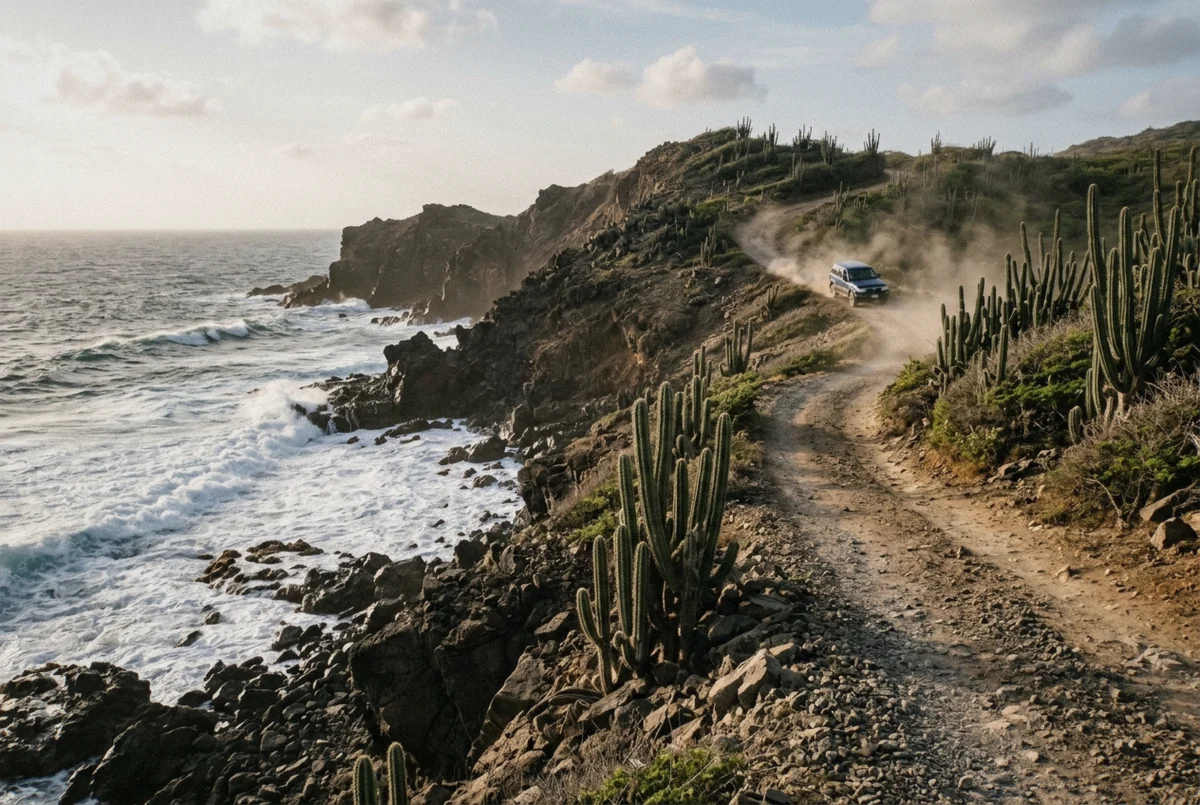
The windward side inside Arikok: dark rock, hard surf and a track that needs a 4x4, and no bookable session goes there.
The Windward Side: Wild, and Entirely Yours
Cross the island, twenty minutes in a car, and Aruba stops being a resort and becomes a desert with a coastline. Nothing on the booking platform shoots here, which is precisely the argument for going.
What the road actually demands
This is the practical fact that ruins more days than the weather. The tracks to Bushiribana, the Natural Bridge, Andicuri and Blackstone are unpaved, rutted and dusty; a small two-wheel-drive rental will physically get to some of them slowly and to others not at all, and every rental agreement on the island excludes damage sustained off paved roads.
The Natural Pool is stricter still: the trail through Arikok is 4x4, UTV, horseback or on foot only, and the park charges admission. If you want the wild coast without renting a jeep, the island's UTV and jeep tour operators run it daily. That is a different booking from anything in our photo session catalogue, and worth making early in the trip so you know what you have before you plan a shoot.
The bridge that is not there
Aruba's Natural Bridge, a coral span the sea had cut over centuries, collapsed in September 2005. Two decades later it is still printed on lists of the island's must-photograph landmarks, and visitors still drive out expecting an arch.
What is there: the fallen span, a genuinely spectacular piece of windward coast, and the smaller Baby Bridge a short walk along the rocks, which survives and is photogenic in its own right. Go knowing that and the trip is good. Go expecting the postcard and it is a wasted hour.
Cactus, goats and the light
The interior between the coasts is desert: candle cactus three metres high, divi-divi trees bent permanently by the wind, loose goats and almost no shade. It is the landscape that makes Aruba look nothing like the rest of the Caribbean, and it photographs best in the last hour before sunset when the low sun separates the cacti from the ground.
Ayo and Casibari are the accessible version of this: paved road, half an hour each, boulders and petroglyphs. Arikok is the committed version. Neither needs a photographer; both need shoes and water.
Best Light, Spot by Spot
Aruba sits at 12° north, which means two things: the sun climbs fast and drops fast, and the usable window moves across the year. Sunset runs from about 18:11 in November to 19:10 in July; sunrise from 06:15 in May to 07:05 in January. Midday is the enemy.
Vertical sun on white sand blows out the highlights and puts every face in raccoon shadow.
| Hour | What it suits | Where to be |
|---|---|---|
| First light (sunrise to +1h) | Empty sand, cool colour, calm water | Eagle Beach, Boca Catalina, Tres Trapi |
| Mid-morning (to about 10am) | Clear-water detail, snorkel-cove colour | Boca Catalina, Mangel Halto, Baby Beach |
| Late morning | Rock and ruin, where shadow is the subject | Ayo, Casibari, Bushiribana |
| Midday | Almost nothing on sand; go inland or eat | Oranjestad streets, Arikok's shaded caves |
| Mid-afternoon | Wind as a subject: kites and sails | Hadicurari, Palm Beach piers |
| Golden hour (last hour before sunset) | Portraits, the whole reason the sessions exist | Eagle Beach, the fofoti trees, Arashi |
| Sunset itself | Silhouettes and the sun down the water | Arashi Beach, California Lighthouse |
| Blue hour (20 minutes after) | Hotel lights, piers, long exposures | Palm Beach, Oranjestad waterfront |
The season nobody mentions
Rainfall is not the variable here. Even December, the wettest month, averages under 90 mm and delivers it as short showers. Wind is the variable. The trade winds blow all year and peak from May to August, which is when hair, dresses and drone footage all get harder, and when the leeward water stops being glass.
September and October are the calmest weeks of the year and the hottest. If your photographs involve fabric, long hair or a drone, that is the window worth targeting, and the month-by-month chart has the pattern.
One Full Photo Day, Hour by Hour
A day that uses every good hour and wastes none of the bad ones, on paved roads only. Times shift with the month; this is written for a February sunrise around 06:55 and sunset around 18:45.
-
06:30
Boca Catalina, before anyone
Park in the lay-by and be on the ledges as the light arrives. The water is at its clearest and the snorkel boats are still an hour away.
-
07:30
Tres Trapi, then Arashi
Five minutes apart. The steps first while the stone is still dry, then Arashi's empty shallows with the light behind you.
-
09:00
California Lighthouse
Not the best light of the day for the tower, but the ridge and the coastline behind it hold up, and it is on the way back.
-
10:30
Ayo and Casibari
Inland, out of the beach glare. Shadows are hard now, which is what boulders and petroglyphs want.
-
12:30
Oranjestad, and lunch
The one place midday is survivable: colour comes from the paint, not the light. Shoot the facades on the shaded side of the street.
-
16:00
Hadicurari
The wind is up and the kites are out. Backlight the sails from the south end of the beach.
-
17:45
Eagle Beach and the fofoti trees
Golden hour. This is the frame the whole day was built around, and the hour every bookable session sells.
-
18:45
Arashi or the lighthouse for the drop
West-facing and open. Then twenty minutes of blue hour on the Palm Beach piers if you still have it in you.
Rules Worth Knowing Before You Shoot
Drones are regulated, and the rules move
Drone use in Aruba is governed by the island's civil aviation authority, with registration and permission requirements that have changed more than once and that tighten sharply near Queen Beatrix International Airport, which sits directly behind the Oranjestad and Eagle Beach coastline. Do not take the presence of drones in tourist photographs as evidence that flying yours is fine.
The practical route around all of this: the clear-kayak sessions fly their own drones under their own arrangements, so an aerial photograph of yourself is a booking rather than a paperwork exercise. If you are bringing your own aircraft, check the current requirements with the authority directly before you pack it.
Arikok is a ticketed national park
Entry to Arikok National Park is charged and the park controls access to the Natural Pool, the caves and the wild beaches inside its boundary, including closing the pool when the surf makes it dangerous. Rangers enforce the vehicle rules on the tracks. Check the park's current rate and opening hours on the day rather than trusting a blog, including this one.
The petroglyphs and the chapel
Ayo's rock markings are Arawak and protected: photograph them, do not touch them, and never chalk or wet them to raise the contrast, which is the standard trick and does permanent damage. Alto Vista is a working chapel, not a set: if a service or a visit is happening, wait or move on.
None of this is heavily policed. All of it is the difference between a visitor and a nuisance.
Sun, wind and your gear
Two practical warnings from the island's own conditions. Blown sand on the windward beaches gets into everything, so change lenses in the car rather than on the rocks. And the sun at this latitude is genuinely severe by 10am.
The shoot that ends in sunburn is the one where you thought the breeze meant it was mild.
Which Session Covers Which Spots
If you want a photographer at any of these locations rather than a tripod, this is the join. Every claim below comes from the operator's own listing.
| Session | Locations it names | Best for |
|---|---|---|
| Family beach shoot | Eagle Beach, Boca Catalina, Arashi Beach, an Oranjestad spot; you choose | Choosing the location yourself |
| Couples beach shoot | Eagle Beach or a secluded coastline | Golden hour on the signature sand |
| Private vacation shoot | Photographer's choice across the leeward coast; not named in advance | Trusting a local with the hour you booked |
| Clear kayak with cocktails | The Palm Beach stretch, shot from a drone | The overhead water frame |
| Clear kayak glam session | The beach behind the resort on Palm Beach | Styled solo portraits with direction |
| Parasail with photographer | Off Palm Beach, next to Moomba Beach Bar | Action shots from the air |
The spots no session reaches
Thirteen of the nineteen locations on this page have no bookable photographer attached: the whole windward coast, the inland rock, the lighthouse, the chapel, Tres Trapi, Mangel Halto and Baby Beach. That is not an oversight in our catalogue. It is the shape of the market. Photography sessions here sell golden hour on calm sand, because that is what visitors book.
So the honest division of labour on this island is: book a session for the pictures of yourself, and drive the rest with your own camera. The Aruba photoshoot catalogue covers the first half; the map above covers the second.
Aruba Photo Spots: What Shooters Ask
What are the best photo spots in Aruba?
Eagle Beach and its fofoti trees for the signature frame, Arashi for a clean west-facing sunset, Boca Catalina and Tres Trapi for clear water in the morning, the California Lighthouse and Alto Vista Chapel for something other than sand, and the windward coast (Bushiribana, Andicuri, Blackstone) for drama nobody else on your feed has. All nineteen sit on the map above with the hour each one wants.
What is the prettiest part of Aruba?
For photography, the northwest corner between Boca Catalina and the California Lighthouse: four distinct backdrops within four kilometres of paved road, all at their best in the same early window. Eagle Beach is the more famous answer and deserves it, but it is busy at exactly the hour it looks best.
Which Aruba photo spots do most lists skip?
Mangel Halto's mangrove channels on the south shore, which photograph green rather than turquoise; Blackstone Beach, black pebbles against white surf, reached on foot; and Ayo's petroglyphs, quieter than Casibari and better in morning light. None has a bookable session, so they are self-shoot locations, which is part of why they are still quiet.
Is the Natural Bridge still there?
No. It collapsed in 2005, and lists of Aruban landmarks have never quite caught up. The smaller Baby Bridge next to it survives, and the coastline around the site is genuinely wild, worth the drive for the surf and the rock rather than for an arch that is not there.
Do I need a 4x4 to reach these spots?
Not for the leeward coast, the lighthouse, the chapel, Oranjestad, Casibari or Ayo, all of them paved. Yes, effectively, for Bushiribana, the Natural Bridge, Andicuri and Blackstone, and absolutely for the Natural Pool, where the trail is 4x4, UTV, horseback or hiking only. Rental agreements exclude off-road damage, so a jeep or UTV tour is often the cheaper way to see the wild half.
Can I fly a drone in Aruba?
Drone use is regulated by the island's civil aviation authority, with registration requirements and hard restrictions near the airport, which sits right behind the main tourist coastline. Rules have changed more than once, so check the current position before travelling. The clear-kayak sessions fly their own drones, which is the simplest way to get an aerial photograph of yourself.
What time is golden hour in Aruba?
The hour before sunset, which runs from about 17:10–18:10 in November to 18:10–19:10 in July. Sunrise sits between 06:15 in May and 07:05 in January. At 12° north the transition is fast, so being ten minutes late costs a real share of the light, and the seasonal chart shows how far the window moves.
Which photographer will take me to these locations?
Only the leeward ones. The family session lets you pick between Eagle Beach, Boca Catalina, Arashi and Oranjestad; the couples session names Eagle Beach; the water sessions work the Palm Beach stretch. Nobody on the booking platform shoots the windward coast or the interior. The full coverage table sets out exactly who goes where.